
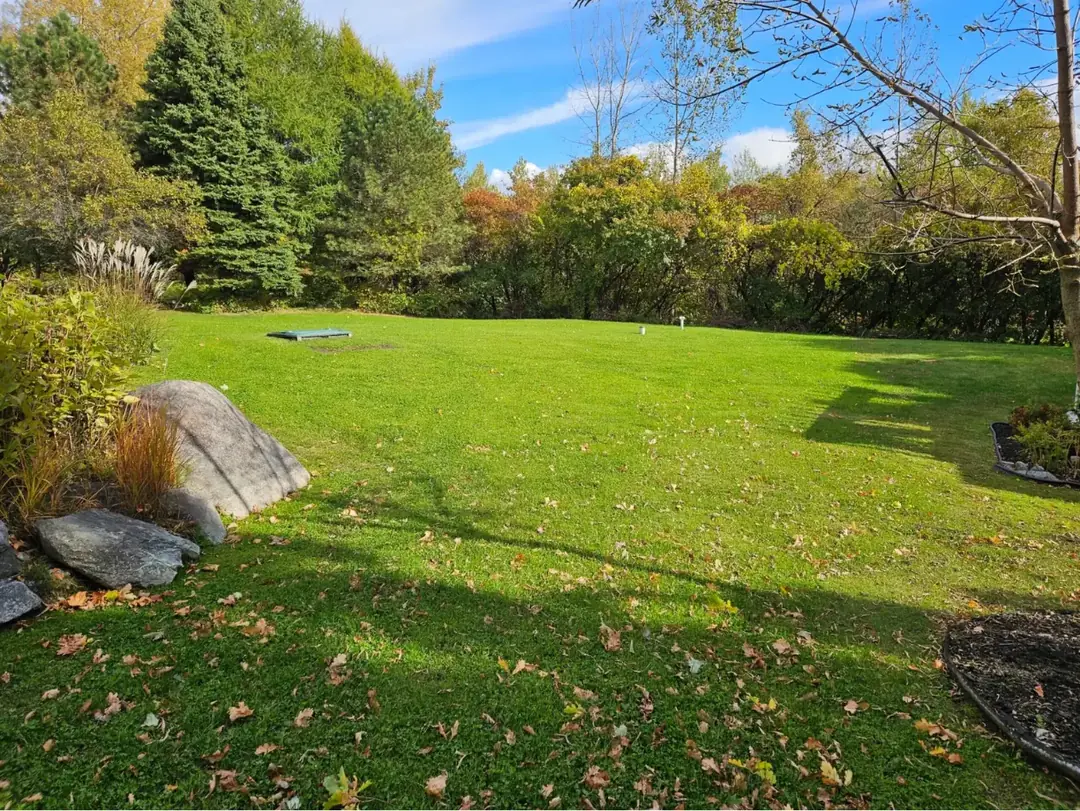
White clover or micro-clover?
| Characteristic | White clover | Micro-clover |
|---|---|---|
| Leaves | Larger | Small, closer to the ground |
| Flowering | Abundant | Generally more discreet, especially if mowed |
| With grass | Can take over | Blends well with grasses |
| Best use | Slopes, hard-to-reach corners, meadow | Front and back lawns |
Our micro-clover is the Pipolina variety, selected for its small leaves and how well it holds up in a mowed lawn.
What clover gives you
- It makes its own nitrogen. Bacteria in its roots capture nitrogen from the air, and the neighbouring grass gradually benefits: about one less fertilizer application a year, according to the University of Maryland.
- It grows low. Micro-clover has small leaves and grows lower than ordinary white clover.
- It flowers for pollinators. Dozens of bee species visit its flowers. Micro-clover flowers less, especially if mowed often.
The City of Boucherville recommends adding dwarf white clover to the lawn, because it doesn't mind drought and is less popular with several pest insects (lawn care calendar, in French). Sources don't agree on drought, however: according to the University of Maryland, micro-clover tolerates heat and drought poorly. All the details, with sources, are in our guide Clover in the lawn (in French).
Limits to know about
- Heavy foot traffic. For a play area or a very busy yard, we recommend a mix of grass and micro-clover rather than clover alone.
- The flowers attract bees. Mowing before it flowers is enough near a patio or a pool.
- Broadleaf weed killers also kill clover. With a clover lawn, you forget about those products.
- Winter. Its above-ground part dies back in winter and can leave bare patches in spring. That's why we prefer to seed it with grasses.
Our options
- Clover and grass package: our Standard mix, with coated white clover added to the mix. Its price is calculated in the estimator on the Pricing page.
- Grass and micro-clover: the look of a classic lawn, with less fertilizer and flowers for pollinators.
- Micro-clover alone: for a very low lawn, with little fertilizer, where traffic is moderate. Good to know: on its own, it doesn't form a thatch and leaves bare patches in winter. The distributor Gloco reports a high risk of frost damage when it's sown alone, and the University of Maryland notes that no research supports this use.
- White clover: for slopes and corners that are hard to mow.
Clover is also a simple way to make your property more useful to bees: see our guide Lawns and biodiversity (in French).