
In brief
- Measure the slope: up to 3:1 (33%), hydroseeding with a wood fibre mulch is generally suitable. Steeper than that, you need a product designed for steep slopes or an erosion control blanket.
- Redirect the water first: eavestroughs, drains and pool draining shouldn't empty onto the slope.
- Where water flows hard, at the bottom of a ditch or along a watercourse, vegetation alone may not be enough.
- Don't leave a slope bare over the winter: dormant seeding on a gentle slope, an erosion control blanket on a steep one.
- On a shoreline or in an area exposed to landslides, talk to your municipality before the work.
Measuring your slope
A slope is often expressed as a ratio “to 1”: a 3:1 slope goes 3 m horizontally for every metre of height. It's also given as a percentage, meaning the height divided by the horizontal distance, or in degrees.
To measure it, rest the end of a straight 1 m board on the slope, on the uphill side, and hold it level with a spirit level. Then measure the distance between the other end of the board and the ground: 33 cm gives a 33% slope, or 3:1. Take the measurement in a few places, because it's often the steepest part that decides the method.
| Slope | In % | In degrees | What you need to know |
|---|---|---|---|
| 4:1 | 25% | 14° | Gentle slope: cellulose is enough, according to the manufacturer Profile. |
| 3:1 | 33% | 18° | Limit for wood fibre according to Profile. Sod must be secured with stakes or staples. |
| 2:1 | 50% | 27° | Steep slope: bonded fibre matrix or blanket. On a shoreline, Quebec's environment ministry advises not exceeding this slope when possible. |
| 1:1 | 100% | 45° | Very steep slope: specialized products, riprap or a retaining structure. |
Redirect the water before seeding
On a slope, water coming from elsewhere often does more damage than the rain falling on it. An eavestrough emptying at the top, a drain, a sloping driveway or a pool being drained concentrate the water in a single spot. The Government of Quebec and the Ministère de la Sécurité publique also ask that no water be directed toward a slope exposed to landslides.
Before seeding, send that water elsewhere: extend the downspouts and direct them toward a stable surface, away from the slope, without sending it onto your neighbour's property. According to the Ohio EPA, a straw mulch has trouble staying in place where water runs off.
The solutions, from the lightest to the sturdiest
Hydroseeding
The seed, mulch and a tackifier are mixed and sprayed together, in a single operation. The surface is covered from day one, with no staples or rolls, and no one has to walk on the freshly prepared soil. The mulch protects the soil from the impact of raindrops and from runoff while the roots take hold.
It all comes down to choosing the mulch. A steep slope calls for a product designed for it, like a bonded fibre matrix. The toughest products go even further: the manufacturer Profile rates its EcoFlex HP-FGM for slopes up to 0.25:1 (4 m of height for 1 m horizontally), with protection that can last up to 18 months. The different mulches are explained in our guide How does hydroseeding work?
Erosion control blankets
This is a roll of straw, coconut fibre or wood fibre that's unrolled over soil that's already been seeded and held down with staples. The Ohio EPA recommends it where a straw mulch has trouble staying in place, because of the slope, the wind or water running off. On a shoreline, on a slope of more than 30%, Quebec's environment ministry recommends protecting seeded areas with jute netting, a material that breaks down.
To work properly, the blanket has to touch the ground everywhere, without being stretched tight. Its edge on the side the water comes from is buried in a small trench, and the rolls overlap (Ohio EPA).
Sod
Sod covers the soil right away, but it can slide on a slope. On a slope of 3:1 or steeper, it has to be secured with stakes or staples and laid perpendicular to the slope (Ohio EPA). It also needs generous watering at first: our comparison hydroseeding or sod gives the details. On a shoreline, Quebec's environment ministry says not to use sod.
Ground covers, shrubs and native plants
On a slope too steep to mow, a low ground cover, clover, shrubs or native plants are often better than grass. John Deere suggests a simple test: if you can't back up the slope with your lawn tractor, or if you feel uncomfortable on it, don't mow it, and plant a ground cover instead. While the plants get established, protect the soil between them with hydroseeding or a blanket.
A slope of clover or native plants can also feed pollinators: see our guide Lawns and biodiversity (in French).
Riprap and walls
When water strikes the bottom of the slope, along a watercourse for example, or when there isn't enough room to make a steep slope gentler, stone is sometimes needed: riprap, also called stone revetment. On shorelines, Quebec's environment ministry reserves these techniques for difficult conditions, such as a steep shoreline where space is limited. It always gives priority to the technique that best restores the natural character of the shoreline, and it advises against retaining walls.
When to act, and what to do before winter
For a lawn, the Ordre des agronomes du Québec gives two periods: May, and mid-August to mid-September. We aim for the same periods for a slope. The other seasons are covered in our guide When to seed grass in Quebec
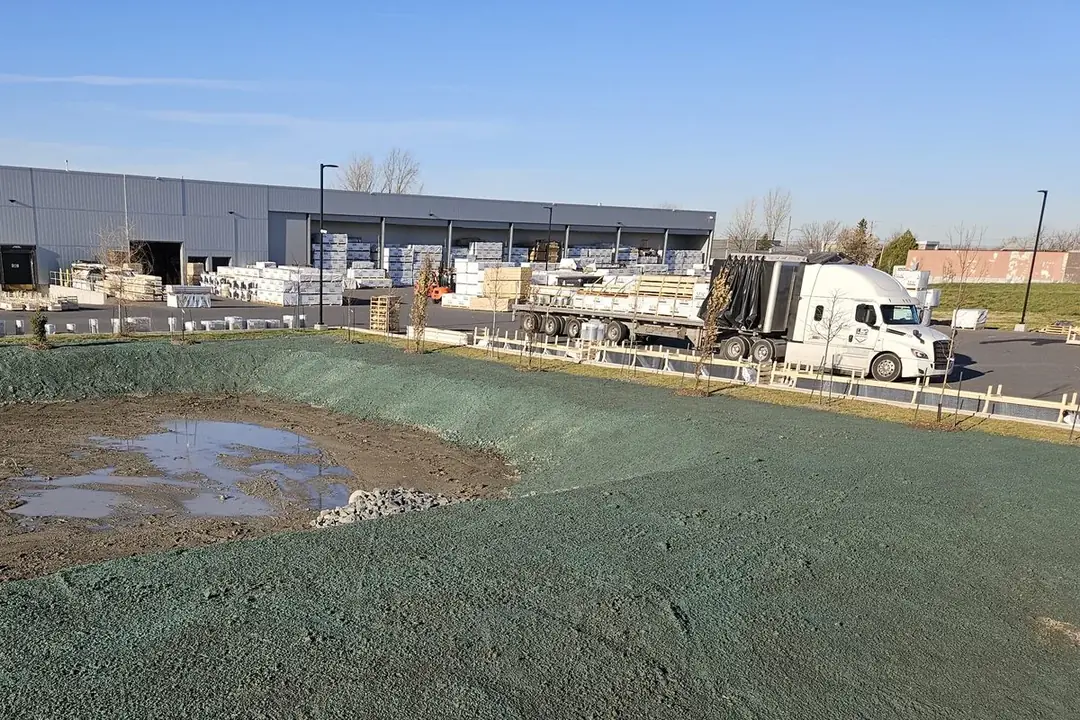
After construction work, don't wait. The erosion control fact sheets distributed by the Missisquoi Bay watershed organization call for protecting exposed soil as quickly as possible, no later than one week after the work, and for leaving no soil bare over the winter. If the work ends late in the fall, they advise covering the soil with mulch and seeding the following spring, never seeding frozen ground.
Dormant seeding does both at once: the mulch covers the soil from the day of application, and the seed stays dormant until spring. It's well suited to gentle slopes. On a steep slope, a quick snowmelt can move the mulch: an erosion control blanket is then safer.
Before touching a slope: two checks
Is it in an area exposed to landslides?
Clay slopes can slide once they reach a certain height and steepness, and in Quebec, these landslides generally happen suddenly (Ministère de la Sécurité publique). The government publishes a map of potentially exposed areas, but it's your municipality that tells you what work is allowed. In many cases, it requires a geotechnical assessment.
Near an at-risk slope, the Government of Quebec and the Ministère de la Sécurité publique ask you to avoid:
- overloading the top with fill, imported soil, stored materials or even snow;
- clearing or digging at the base, for example for a shed or an in-ground pool;
- directing water toward the slope: eavestrough, drain, septic field or pool draining.
A crack in the ground, a bulge in the slope, a collapse or an unusual flow of water should be reported to your municipality (Government of Quebec). It's no longer a matter of grass.
Is it on the shoreline of a lake or watercourse?
The shoreline is protected. It's a strip of 10 or 15 m depending on the slope and the height of the bank, but your municipality can require a wider shoreline: it or your RCM can confirm the width that applies to your property (Government of Quebec). Before stabilizing a shoreline, you have to obtain all the required authorizations; for private land, contact your municipality (Quebec's environment ministry). Vegetation is preferred there: once the authorization is obtained, we'll help you choose a mix of native plants suited to the site.
How we work
On your slope, we look at the steepness, the water and the soil before suggesting anything, and we'll tell you honestly whether hydroseeding is enough or whether a blanket, stone or an expert's opinion is needed. See our slopes and erosion control service, or send us photos of your slope. For a road, ditch or construction-site slope, see our pages for MTQ contracts and contractors and developers.
Sources
- Government of Quebec, landslides and delimitation of shorelines and the littoral zone (in French).
- Ministère de la Sécurité publique, Ministère des Transports and Ministère des Affaires municipales, leaflet on living in an area exposed to landslides (in French).
- Données Québec, areas potentially exposed to landslides (in French).
- Quebec's Ministère de l'Environnement, technical sheet on shoreline stabilization, updated in 2011 (in French).
- Organisme de bassin versant de la baie Missisquoi, erosion control fact sheets (sheets 2.1 and 2.6, in French).
- Profile Products, hydraulic mulch application guide and EcoFlex HP-FGM data sheet.
- Ohio EPA, Rainwater and Land Development, 2025: Sod Stabilization and Erosion Control Blanket.
- John Deere, landscaping safety tips.
- Ordre des agronomes du Québec, ecological lawn care (in French).