
In brief
Hydroseeding means spraying a mix of water, seed, fibre mulch, fertilizer and a tackifier under pressure onto prepared soil. The mulch keeps the seed moist and protects the soil during germination. Success depends mainly on two things: soil preparation and watering in the first few weeks.
What is hydroseeding?
The Office québécois de la langue française (OQLF) describes it under the French name ensemencement hydraulique: a mix of water, mulch, seed, fertilizers and sometimes a tackifier, which must be non-polluting, is sprayed under pressure onto the ground. According to the OQLF, the method gives the seed “good conditions for quick germination”. In French, it's also called hydroensemencement.
The technique was developed to seed the sides of highways. In 1953, Charles Finn developed the first commercial hydroseeder; in 1961, International Paper launched a wood fibre mulch. Today it's used as much for residential lawns as for slopes, ditches and large construction sites.
What's in the tank
Everything is mixed in the hydroseeder's tank, so the mix stays uniform from the beginning to the end of the application.
| Component | Its role |
|---|---|
| Seed | It forms the lawn. The mix is chosen according to sun, soil and how the property is used. |
| Fibre mulch | It protects the soil from the impact of raindrops and from runoff, and keeps moisture around the seed. |
| Tackifier | It binds the fibres together and holds the mulch to the ground. |
| Starter fertilizer | It feeds the young shoots. Ideally, it's chosen based on a soil test. |
| Dye | It shows the areas already covered during application. It's biodegradable and fades in a few days. |
| Water | It carries everything and starts germination. |
Our residential packages add a biostimulant to the mix. For seed, the Standard package uses Gloco's Herbionik Hydro-Résidentiel mix: creeping red fescue, perennial ryegrass, Kentucky bluegrass, hard fescue and sheep fescue. On public projects, we apply the mix required by the specifications, such as MTQ mix No. 1. The role of each species is explained in our guide to lawn grasses (in French).
One detail matters: the Ministère des Transports specifications prohibit seed from sitting in water for more than 2 hours before spreading. So the mix has to be sprayed shortly after it's prepared.
Mulch, what makes the difference
Mulch is what sets hydroseeding apart from simple broadcast seeding. Compared with bare soil, it gives better results: in a Penn State University trial, all the mulched plots performed better than the plot without mulch. In Ontario, trials at the University of Guelph gave the lowest quality and the most weeds with dry seeding, and the best result with hydro-mulching at the end of the second trial.
You still have to be realistic, though. In a greenhouse, bare soil reached the wilting point before day 4 without water, compared with day 5 under a hydraulic mulch: the advantage is real, but modest. In the field, the same study found no clear advantage of hydraulic mulch over straw. Mulch helps the seed come up, but it never replaces watering.
Types of mulch, and why the slope matters
- Cellulose, made from shredded paper: for flat ground and gentle slopes.
- Wood fibre, alone or blended with cellulose: more resistant.
- Bonded fibre matrix (BFM): long wood fibres bound by a water-resistant agent, with no paper, for steep slopes.
The limits vary by product and by source, and we always follow the manufacturer's. For example, the manufacturer Profile reserves cellulose for slopes of 4:1 or less (4 m horizontally for every 1 m of height, or 25%) and accepts wood fibre and blends up to 3:1 (33%). Bonded fibre matrices go further: up to 2:1, or even 1:1, depending on the source.
Our mulch combines wood, cellulose and straw. On a very steep slope or at the bottom of a ditch where water flows fast, hydroseeding alone may not be enough: see our service for slopes and erosion control.
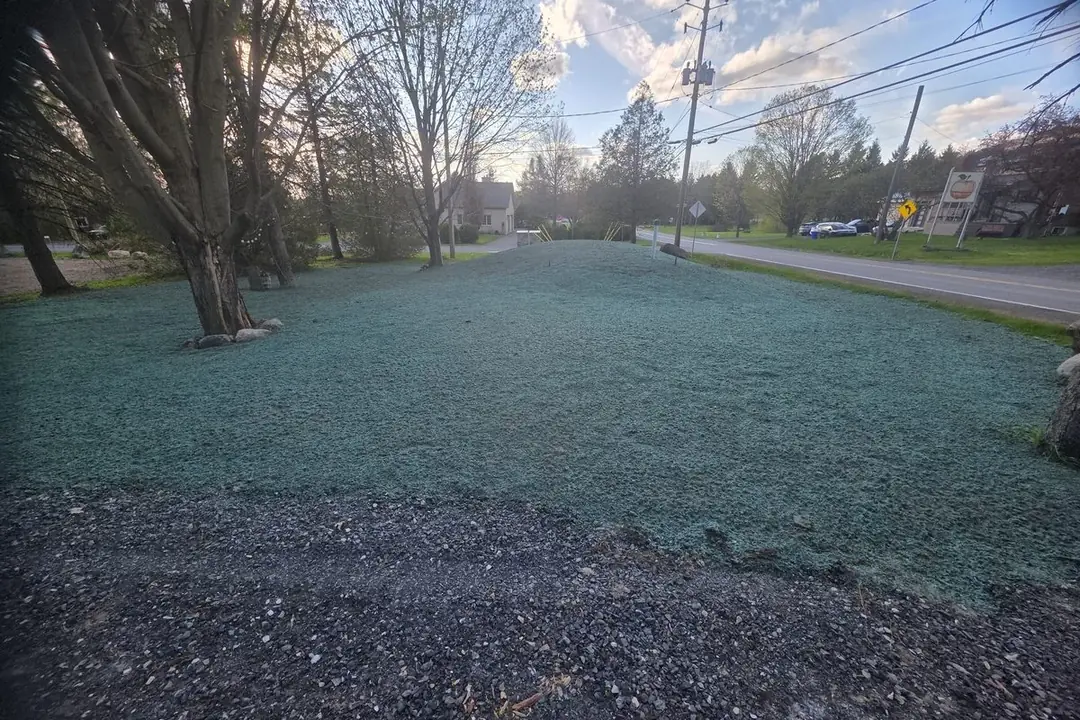
The steps, from bare ground to the first mowing
- Soil preparation. At least 10 cm (4 in.) of lawn soil, levelled and loosened, with no rocks or debris. All the details are in our guide Preparing your property for grass.
- Mixing. Seed, mulch, fertilizer, tackifier and dye are mixed in the tank.
- Application. The mix is sprayed by hose in a single pass. No one has to walk on the prepared soil, and the dye shows the areas covered.
- Drying. The mulch has to dry without rain: 24 to 48 hours, depending on the manufacturer. That's why we avoid applying it just before a forecast storm.
- Watering. Short, frequent waterings keep the surface moist until the seed comes up. Our lawn care guide gives the schedule, week by week.
- Germination. About one week for perennial ryegrass, one to two weeks for fescues and two to three weeks for Kentucky bluegrass, if the soil stays moist.
- The first mowing. When the grass reaches 8 to 10 cm, usually 4 to 6 weeks after application.
Why an application can fail
- Lack of water. This is the most common cause. In a study carried out for the North Carolina Department of Transportation, pots watered only every 10 days no longer had any living grass, and the authors recommend temporary irrigation. That's the role of our temporary watering service.
- Heavy rain before drying, which can move the mulch, especially on a slope.
- Frozen or waterlogged soil. Public specifications prohibit seeding in these conditions.
- Seed left in water too long, more than 2 hours before spreading.
- Strong wind. Some specifications prohibit application in winds over 10 km/h.
- Rushed preparation: soil that's too thin, compacted or full of debris.
On public projects
For roads, Quebec's Ministère des Transports governs hydraulic seeding in its Cahier des charges et devis généraux (CCDG, section 19) and in its standard 9101 on landscaping materials. They include, among other things:
- Canada No. 1 grade seed, and no coated seed;
- a 100 mm layer of topsoil after settling, cleared of stones 50 mm and larger;
- seeding periods: from the end of the thaw to June 15, and from August 1 to September 15; after September 15, the contractor must plan protective measures for the winter;
- fertilizer spread outside the shoreline and the littoral zone.
We work to these specifications for contractors, municipalities and industries: see our commercial service and our pages for contractors, municipalities and MTQ contracts. For a house, the comparison with sod is in the guide Hydroseeding or sod, and prices are on our pricing page.
Sources
- Office québécois de la langue française, “ensemencement hydraulique” entry, Grand dictionnaire terminologique, 2007 (in French).
- Weeds Trees & Turf, history of hydroseeding, September 1986.
- Weeds Trees & Turf, article on tackifier and dye, January 2000.
- Delaware DNREC, Mulching, 2023.
- Iowa DOT, Construction Manual, section 7.30.
- University of Wisconsin, Lawn Establishment and Renovation (A3434).
- Profile Products, hydraulic mulch application guide.
- NC DEQ, rolled and hydraulic erosion control products.
- McLaughlin and Lee, NC State University for the NCDOT, report on mulches and soil moisture, 2013.
- Hole Notes, Penn State mulch trial, November 1999.
- Jordan and Lyons, University of Guelph, conference abstract on establishment methods, 2010.
- University of Tennessee, W160-B fact sheet on grasses, 2023.
- Penn State Extension, Turfgrass Species for Pennsylvania.
- The Jacques Cartier and Champlain Bridges Incorporated, landscaping specifications, 2018 (in French).
- Government of Canada, federal specifications published on CanadaBuys, 2018 (in French).
- Ministère des Transports, standard 9101, Matériaux pour l'aménagement paysager, 2009 version, and Info-Normes, winter 2020 (in French).
- Ministère des Transports, Cahier des charges et devis généraux (CCDG), section 19, “Aménagement paysager”, 2025 edition (paid publication, in French).